2025 Kawasaki KLX230 S review: 12 months on the tracks
After a year riding Kawasaki’s small-capacity dual-sport, here’s what works, what frustrates me and why it still gets a spot in the shed.
Published on: 30 October 2026

Like most bike lovers, I’ve got a few bikes in the shed. There’s always a reason for another one, even if explaining that reason sometimes requires a little creativity.
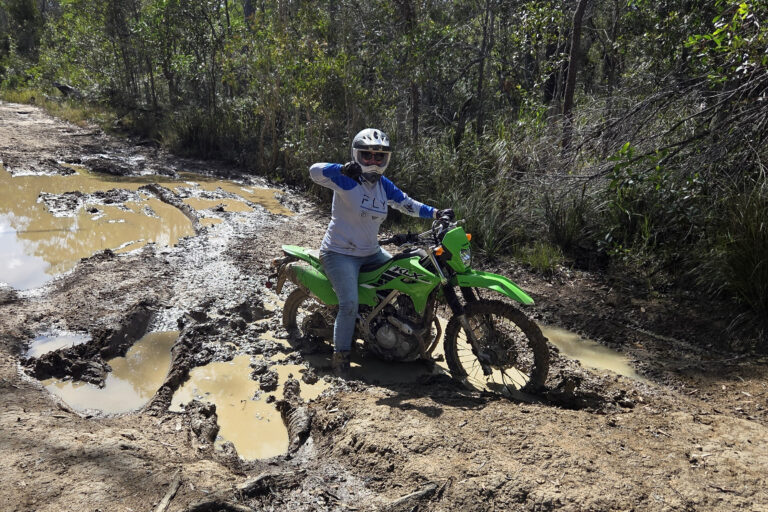
For the past 12 months, I’ve been riding a 2025 Kawasaki KLX230 S. Mine is completely stock, with no modifications, and it’s had enough time on the tracks for me to work out what I like and what I’d change.
For context, I’m 162cm tall and ride mainly to explore. I like finding out where a track goes, having some fun along the way and coming home without needing a lie-down and an ice pack. I’m not a particularly aggressive rider, and launching off jumps isn’t what I bought this bike for.
The KLX makes a lot of sense for my kind of riding, but it also has a few compromises worth knowing about before you hand over your money.

Finding a dirt bike that suits my height and weight hasn’t been straightforward. I’m short, but I’m not super skinny, either. Simply choosing a smaller bike doesn’t necessarily solve the problem. A smaller Honda CRF125 might make reaching the ground easier, but that doesn’t automatically make the rest of the bike a good fit.
The KLX230 S gives me a useful middle ground. Its 845mm seat height is a big part of the appeal, while full-size wheels mean it still has the proportions of a proper trail bike. For me, that lower stance is appreciated as it makes stopping on uneven ground and negotiating awkward sections much easier as I like to get a solid foot down. I’m on the ball of my foot when straddling the bike and do need to lean a little to get one foot down flat.
Once aboard, I find it comfortable. The handlebars are in a relaxed position, and the overall ergonomics are great without any modifications. Getting on and off, strangely enough, is less comfortable. More on that shortly.

The engine is a fuel-injected, air-cooled 233cc four-stroke single, with a two-valve, single-overhead-cam layout.
What matters to me on the track is how it delivers its power. Down low, it’s manageable and easy to work with, particularly when I’m puttering through a technical section or picking a line around an obstacle. I also really like the gear spacing, with useful ratios for working through slower sections and moving along when the track opens up.
The highway is where the little engine starts showing its limits. Sustained higher speeds feel like hard work, and inclines at these higher speed make that more obvious. It’ll handle road sections, but it’s not where I find it particularly comfortable.
That isn’t a complaint about the gearbox. I like the ratios, I’d just like a bit more grunt if I was to ride it on the highway longer distances between tracks.

The suspension feels soft and comfortable for general trail riding but it’s a bit too soft for really aggressive riding. The rear shock has adjustable spring preload, which gives some scope to set the bike up for the rider’s weight. Just remember that preload adjustment helps establish the ride height and sag, but it doesn’t change the spring rate or turn the suspension into a competition setup.
For heavier riders or anyone planning to push harder, the suspension setup will need attention. My riding doesn’t involve big jumps or charging into every rough section, so I’m not going to pretend I’ve tested its limits that way but I have bottomed it out a few times when I’ve accidently gotten some air, or ridden really rough tracks a little more aggressively than I usually would.
For exploring tracks, it suits me. It’s also quite good in tight turns, making it manageable when there’s a bit of fiddly manoeuvring involved.

One feature I’m pleased Kawasaki included is the ability to switch the ABS on and off. The system allows ABS to be disabled on both wheels for off-road riding. Prior to 2024, it could only be deactivated on the back wheel.
ABS works by modulating brake pressure when it detects a wheel locking. That’s useful reassurance on the road but can be dangerous off-road where the rules of traction are completely different. On a bike that’s intended to do both jobs, having this choice is a good thing as on the road, a skid means a crash, but in the dirt, a skid is a tool for control.
Electric start is firmly on my list of positives. Pressing a button is convenient, especially when you’re already dealing with an awkward bit of track, but I still like a kickstarter as a backup. The KLX 230 S doesn’t have one.
Electric-only starting has always made me nervous a little on bikes meant to take you exploring. If you’re deep in the scrub and the starting system lets you down, having an easier way to turn the engine over (other than bump starting it) would offer some peace of mind.
I know a kickstarter wouldn’t solve every starting problem, particularly on a fuel-injected bike that still needs functioning electronics and fuel delivery. Even so, I’d appreciate the extra option.
Kawasaki lists the KLX230 S at 132kg kerb weight. That includes the fluids and fuel needed to ride it, rather than being a dry figure. On the move, it’s manageable enough to flick around the tracks. On the ground, I have a slightly different opinion of its claim to being lightweight.
If I drop it and it lands awkwardly, picking it up is really difficult for me. The lower seat helps while I’m riding, but it doesn’t make the bike weigh any less when it’s on its side. It’s worth keeping in mind for those not made of muscle, as there are other bike options out there and an accessible seat height is only part of finding the right bike for you.

Despite the lower seat, I find getting on and off the KLX surprisingly awkward. Granted, my legs don’t swing as high as they used to. But there’s something about the process that takes more effort than I expected.
I haven’t worked out whether it’s how the bike leans on the sidestand, the shape of the rear of the bike or simply how it works with my proportions. I’d be guessing if I blamed one particular thing. Once seated, I’m comfortable. Getting there just isn’t always graceful.
If you’re looking at one because you’re short, spend time getting on and off it as well as sitting on it in the showroom.

The KLX230 S suits the riding I actually enjoy. It’s comfortable, the power is predictable and the gearbox works well when I’m exploring tracks at my own pace. Its lower seat helps make it a practical option for me at 162cm, without having to squeeze myself onto a much smaller bike.
I’d like less weight , a backup kickstarter and a bit more breathing room on the highway at speed. Those are the compromises I notice after a year of riding it. Despite buying a dual-sport, I haven’t actually found myself riding on the road very much as my house and property backs onto trails and therefore the latter comprimise isn’t that much of a problem.
But when I’m out on a track, having a look around and deciding which turn to take next, or out riding with the kids, the Kawasaki does the job I bought it for and for a reasonable price. That’s a pretty good reason to keep its spot in the shed.

Cost: Around $8,432 ride away.
| Specification (Australian model) | Detail |
|---|---|
| Engine | 233cc air-cooled four-stroke single |
| Valve arrangement | SOHC, two valves |
| Bore × stroke | 67.0 × 66.0mm |
| Compression ratio | 9.4:1 |
| Fuel system | Fuel injection, 32mm throttle body |
| Maximum power | 13.2kW at 8,000rpm |
| Maximum torque | 18Nm at 6,400rpm |
| Starting | Electric |
| Transmission | Six-speed |
| Clutch | Wet multi-plate, manual |
| Final drive | Chain |
| Frame | High-tensile steel perimeter |
| Front suspension | 37mm telescopic fork |
| Rear suspension | Uni-Trak, adjustable spring preload |
| Front brake | 265mm petal disc, two-piston caliper |
| Rear brake | 220mm petal disc, single-piston caliper |
| ABS | Switchable front and rear |
| Wheels | 21-inch front, 18-inch rear |
| Seat height | 845mm |
| Ground clearance | 240mm |
| Wheelbase | 1,365mm |
| Fuel capacity | 7.6 litres |
| Kerb weight | 132kg |
| Estimated dry weight | 125kg |