Kawasaki’s four-legged CORLEO could make off-road riding very weird
Kawasaki’s hydrogen-powered CORLEO has four legs and production ambitions. Here’s what’s planned for the unusual off-roader shown at EICMA.
Published on: 17 November 2026

I ride motorbikes because horses have a mind of their own. Now Kawasaki is developing a four-legged robot that you ride like a horse, and I’m going to need a minute.
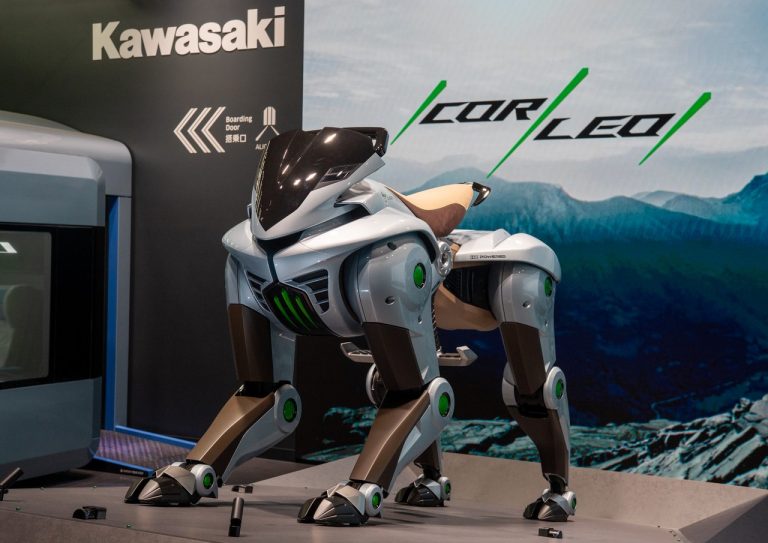
You’ve probably seen the CGI clips of the Kawasaki CORLEO doing the rounds on social media over the past year. But Kawasaki has ambitions beyond impressive animation: it brought a full-scale mock-up to EICMA 2026 and is targeting commercialisation around 2035.
So, could we eventually be saddling up on hydrogen-powered robots for a day in the bush? Here’s what Kawasaki has planned.

Kawasaki calls it a Robotic Multi-legged Vehicle, or RMV (yes, they just invented a new recreational vehicle type). Which sounds very official for something that most of us will simply describe as a robot horse.
The idea is to combine Kawasaki’s motorcycle know-how with the wider group’s robotics expertise, creating a machine that carries a rider across rough ground on four articulated legs.
Instead of rolling over obstacles, it would step over them. Kawasaki’s original concept includes split rubber hooves designed to adapt to uneven surfaces, with grass, rocks and rubble among the intended terrain.
I don’t know about you, but for me, it’s an exciting concept to be able to go further than where my bike and feet can currently take me.

According to Kawasaki’s latest EICMA announcement, the proposed power source is a 150cc hydrogen-fuelled engine. That engine generates electricity, which powers the drive units in the legs. Hydrogen would be carried in canisters at the rear of the vehicle.
So, while it has an engine, CORLEO’s propulsion system is quite different from a motorcycle sending power through a gearbox and chain to a rear wheel. There’s no useful real-world range figure in the announcements supplied, nor enough information to work out how refuelling would work when you’re out exploring.
Kawasaki says rider weight shifts would control CORLEO, much like riding a horse or motorcycle. The original concept describes inputs detected through the foot supports and handlebars, with the machine monitoring the rider’s movements.
Kawasaki is also developing navigation intended to account for weather, temperature, surface conditions and wildlife when suggesting routes. Information would be available through the instrument panel and smart devices.
That’s an ambitious wish list. We’d settle for navigation that understands the difference between a pleasant bush track and three hours of mud, sweat, tears and regret.

The CORLEO displayed at EICMA was a full-scale mock-up. Its appearance at a motorcycle show doesn’t mean Kawasaki has demonstrated a rideable machine doing everything seen in the concept videos.
What it does have is a development programme and a commercialisation target. Kawasaki’s published roadmap gives us a clearer idea of the plan:
The initial focus seems to be on puting CORLEO closer to an adventure-tourism experience than something you could eventually buy from your local bike shop. Of course, there’s still plenty to prove, including range, durability, terrain capability and what happens when things go wrong somewhere inconvenient.

Kawasaki says it’s using model-based development and AI to run thousands of virtual tests, including falls, impacts and extreme terrain. In plain English, that means designing and testing the system in a computer, identifying problems and refining it before those mistakes become real-world tumbles.
For once, someone else gets to do the falling off. Even if that someone is virtual. However, I’d happily put my hand up to test it (real-world tumbles and all) for free… just saying.
The material released so far doesn’t establish an Australian launch, price or local sales plan. With the roadmap pointing mainly towards tourism and leisure operators, it’s also too early to assume private buyers will be the first customers. For now, CORLEO is an interesting glimpse at what Kawasaki thinks off-road recreation might eventually look like.
Would you trade two wheels for four robotic legs? I’d definitely want a test ride first.