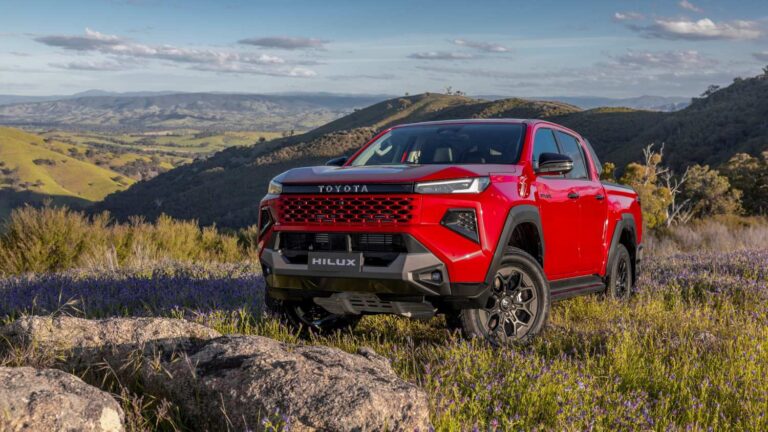
Toyota says your diesel HiLux can run without diesel
Toyota confirms diesel HiLux models built from mid-2015 can run on 100% HVO100 renewable fuel, with more diesel models set to follow.
Published on: 31 August 2026

Toyota has confirmed more than half a million HiLux utes already on Australian roads are capable of running on 100 per cent HVO100 renewable fuel.
If you own a diesel Toyota HiLux built from mid-2015 onwards, it turns out you don’t necessarily need diesel to keep it running. Toyota Australia has confirmed HiLux models equipped with its 1GD or 2GD turbo-diesel engines are compatible with HVO100, a low-carbon liquid fuel made from renewable feedstocks including vegetable oil and recycled cooking oil.
The announcement forms part of Toyota’s broader push to investigate alternatives to conventional fossil fuels, particularly for vehicles and regions where switching to battery-electric power isn’t necessarily practical.
And Toyota isn’t just testing it in a laboratory. An HVO100-powered HiLux has already completed an approximately 3,000km journey through regional Queensland, New South Wales, Victoria and South Australia.
Not quite in the way you might be imagining. HVO stands for hydrotreated vegetable oil, and HVO100 is a processed renewable fuel designed for use in compatible diesel engines. Toyota says it can be produced from renewable sources including vegetable oil and recycled cooking oil.
In other words, don’t start collecting old chip oil and pouring it into your HiLux.
The important part for owners is that Toyota says all HiLux vehicles built from mid-2015 with the 1GD or 2GD turbo-diesel engine are capable of running on 100 per cent HVO100 without requiring conventional diesel. That covers N80 and N90-generation HiLux models, of which Toyota says there are now more than half a million on Australian roads.
Toyota also says all of its existing diesel vehicles can currently operate on a blend containing 20 per cent low-carbon liquid fuel, while the company is studying HVO100 compatibility for additional diesel models.
The point of this isn’t simply that an alternative fuel exists. It’s that Toyota sees low-carbon liquid fuels as one potential way to reduce emissions without giving up the characteristics that make diesel vehicles so useful in the first place.
Range, towing capacity and the ability to refuel quickly remain important for regional Australians and anyone travelling through remote parts of the country. Toyota argues low-carbon liquid fuels could provide another option in areas where electric vehicles aren’t yet a practical replacement for diesel-powered vehicles.
“At Toyota, we believe decarbonisation requires a multi-pathway approach that gives customers practical choices while supporting Australia’s transition to a lower-emissions future,” Toyota Australia CEO and President Matthew Callachor said.
“The confirmation that HiLux models from 2015 onwards can run on 100 per cent hydrotreated vegetable oil is validation that the vehicle technology exists today.”
Toyota has already put the idea to the test on Australian roads. As part of its work exploring low-carbon liquid fuels, an HVO100-powered HiLux completed an approximately 3,000km road trip through regional Queensland, New South Wales, Victoria and South Australia in conjunction with the National Bush Summit.
According to Toyota, the trip demonstrated that the fuel could provide lower-emission transport while retaining the reliability, capability and driving range required by regional users.
And this is where things become a little less straightforward for the average HiLux owner. Confirming that hundreds of thousands of existing vehicles can use HVO100 is one thing. Making the fuel readily available to Australian motorists is another.
Toyota says it supports the development of a domestic low-carbon liquid fuels industry and specifically pointed to the Brisbane Renewable Fuels project being explored by Ampol, GrainCorp and IFM Investors. The company argues domestic production could not only increase the availability of lower-emission fuels but also support regional industries and improve Australia’s fuel security.
For now, the significance of Toyota’s announcement is therefore less about HiLux owners rushing out to fill their tanks with HVO100 tomorrow and more about what could become possible as production and availability increase.
Possibly. Toyota has confirmed it is studying the expansion of HVO100 compatibility to other diesel models, although it hasn’t yet announced which vehicles will be next. Given the number of diesel-powered Toyotas travelling, towing and working across Australia, it’s a topic to keep an eye on.
The bigger question now isn’t whether the technology works. Toyota says more than half a million HiLux vehicles already on Australian roads are capable of using HVO100. It’s whether Australia can produce and distribute enough of the stuff to make filling a 4WD with renewable fuel a realistic option for everyday drivers.