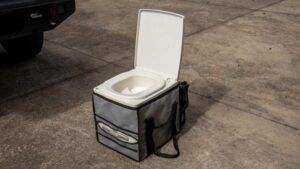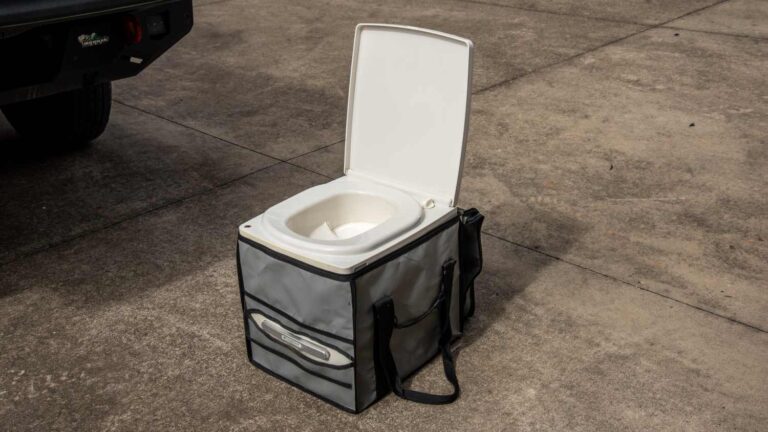
Cuddy Compost Toilet review: Is it any good for 4WD camping?
We put the Cuddy compost toilet to the test to see how it handles real-world camping, from setup and smells to emptying, cleaning and 4WD travel.
Published on: 4 September 2026

Can a composting toilet really mean fewer trips to the dump point, less smell and an easier time camping off-grid? We bought a Cuddy compost toilet to find out.
If there’s one thing that can make camping complicated, it’s going to the toilet.
There are four of us in our family, two of us of the female variety, and when we’re relying on a portable chemical toilet, it means needing to empty it every few days. That’s ridiculously inconvenient when you’re camped somewhere remote and the nearest dump point is nowhere near where you actually want to be.
Also, it’s a chore and camping is supposed to be fun.
The alternatives aren’t always particularly appealing either. Public toilets are often disgusting, if they’re available at all, and digging a hole isn’t always appropriate, easy or even permitted. And, to be perfectly frank, digging a hole to do my business isn’t high on my list of preferred camping activities.
Chemical toilets come with their own issues around smells, chemicals and waste disposal, so I started looking for something that would work for vehicle and camper trailer based camping without requiring a permanent installation. Ideally, I also wanted something that could potentially be a better environmental choice than a conventional chemical toilet.
That led me to buying the Cuddy compost toilet (I also bought the optional travel bag).
What really sold me on the idea was the potential to go considerably longer between emptying the toilet and, thanks to the way a composting toilet separates liquids from solids, deal with far less smell in the process. Both sounded like pretty solid reasons to give it a go.
But composting toilets make some pretty big promises when it comes to convenience, smells and off-grid camping. After actually using the Cuddy in the real world, the question is: does it live up to them?
| Feature | CompoCloset Cuddy |
|---|---|
| Toilet type | Urine-diverting composting toilet |
| Portable | Yes |
| Water required | No |
| Chemicals required | No |
| Urine capacity | 6.5L |
| Solids capacity | 14.7L |
| Power | Not required but you can use the supplied 12V exhaust fan if you want to help with condensation |
| Dimensions | 422mm (H) × 385mm (W) × 432mm (D) |
| Weight | 9.5kg |
| Agitator | Yes (you can buy a ‘lite’ version without an agitator) |
| Carry/travel bag | Optional |
| Price | $1795 |
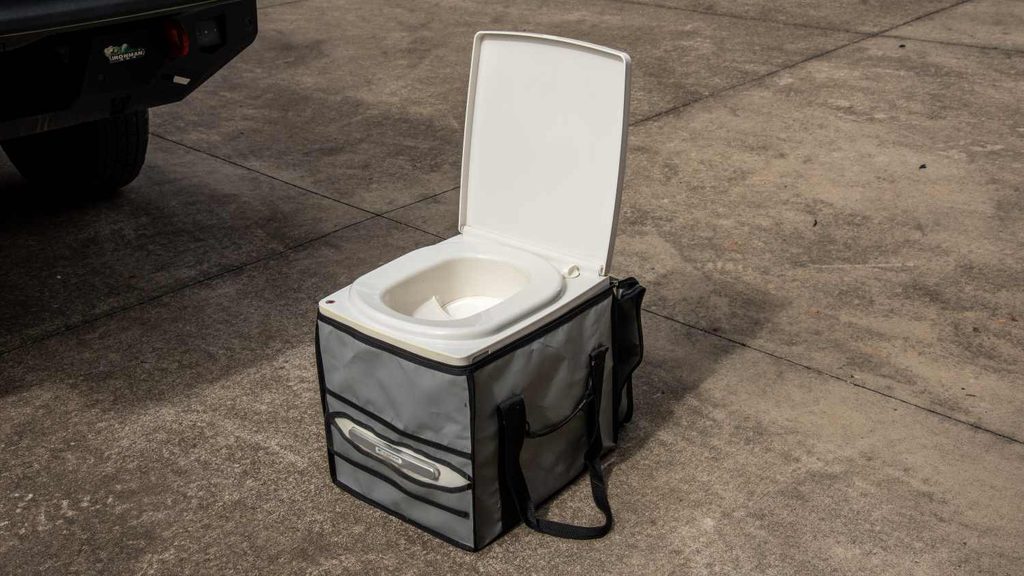
The Cuddy is a compact, portable composting toilet designed for camping, caravans, boats, tiny homes and more. It doesn’t use water or chemicals and is small enough to work as a portable camping toilet without feeling like you’re sitting on something designed for a toddler. If you do want to permanently install it in your off-road caravan, you can do that to.
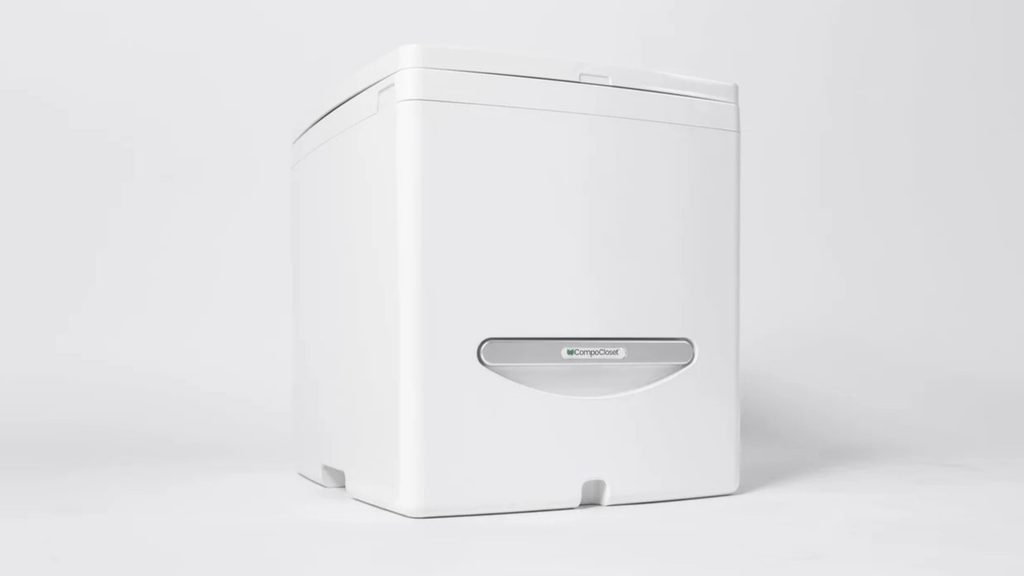
If you’ve never used a composting toilet before, the idea of carrying around a container of poo in the back of your 4WD probably doesn’t sound like much of an improvement over a chemical toilet. But the key to how a composting toilet works is surprisingly simple: it keeps your wees and poos separate.
Unlike a chemical toilet, where everything ends up together in one cassette and essentially becomes sewage, a urine-diverting composting toilet directs liquid waste into one container and solid waste into another. Keeping the two separate reduces odour and allows the solids to begin breaking down rather than sitting in a tank of liquid waste.
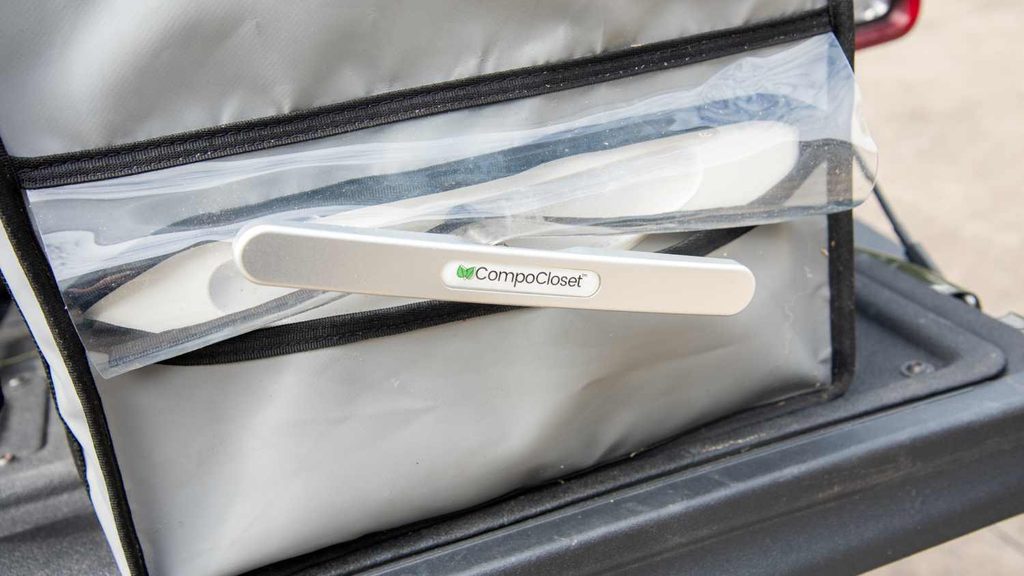
After doing a number two, you use the crank handle on the front of the Cuddy to turn the agitator inside the solids bin. This mixes the waste through the composting medium, while aeration helps create conditions for microorganisms and bacteria to begin the decomposition process.
And before you picture yourself driving around with a festering bucket of poo in the back of your 4WD, there’s another important part of the equation: airflow. The Cuddy has an internal fan and carbon filter to help keep the solids aerated and control odours. It can also be externally vented if you’re installing it inside an off-road RV permanently.
The result of all this, is that the liquid bottle needs to be emptied more frequently than the solids bin. But because it contains urine only and no chemicals, it’s as simple as tipping it down a regular toilet. CompoCloset says the Cuddy’s 14.7-litre solids capacity can provide around two to three weeks of full-time use for two people, although how long you actually get between empties will obviously depend on how many people are using it and how often.
For campers, the big potential advantage is that instead of dealing with one tank containing a mixture of urine, faeces, flush water and chemicals every few days, you’re dealing with two separate waste streams, with the solids requiring attention far less frequently.
At least, that’s the theory. One of the things I particularly wanted to find out with the Cuddy was whether that translated into less smell and fewer unpleasant toilet-emptying duties in the real world.
If you want a more comprehensive look at how and why composting toilets work, you can read my article on Composting Toilets for Caravans over at RVDaily.

Straight out of the box, setting up the Cuddy was surprisingly straightforward. Ours arrived quickly, was well packaged and there was no damage from shipping.
There’s very little assembly required other than to remove packaging tape and install the supplied charcoal filter and fan. The Cuddy comes with clear instructions and the whole process only takes a few minutes.
The part that took me the longest was actually preparing the composting medium.
For our Cuddy, we went with a Brunnings 15L Coir Peat Brick from Bunnings. Coco coir was commonly recommended by other composting toilet users online and in forums, it’s inexpensive and, importantly when you’re travelling, it’s easy to get hold of.
The coir comes as a compressed brick, so you need to add water to break it apart and create the loose composting medium that goes into the solids bin. There’s a bit of a knack to getting the consistency right. You don’t want it too dry, but you don’t want it soaking wet either.
Once you’ve done it once, it’s much easier to judge. The Cuddy also comes with a large ziplock wet bag, so you can prepare some additional coco coir before leaving home and take it with you for topping up or changing the solids medium on longer trips.
The Cuddy can also be connected to an external ventilation setup if you want additional airflow. We hooked ours up when we first got the toilet to try it out, but in practice, we’ve never ended up using it while camping.
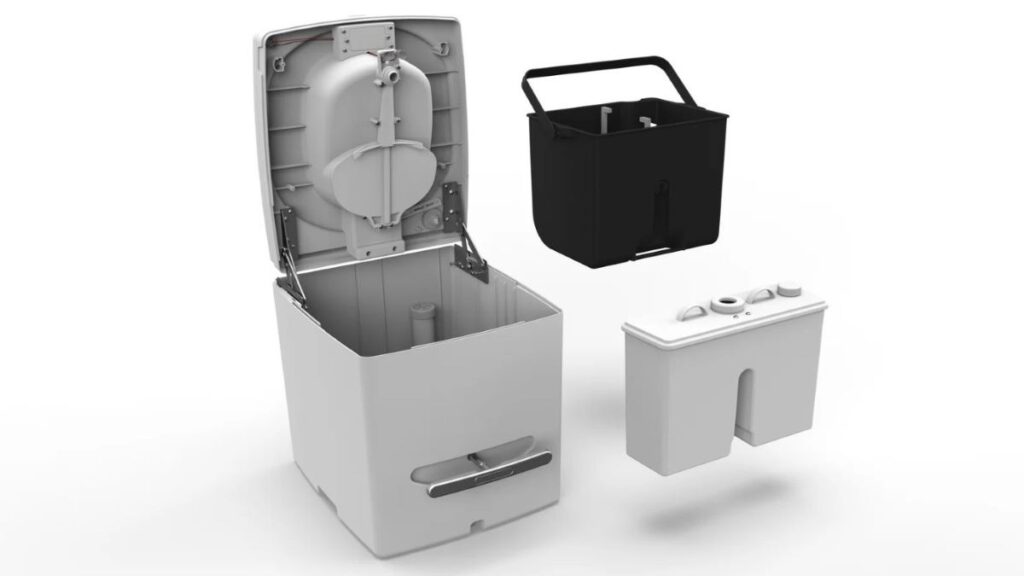
All up, I’d say it took us about 15 minutes to get the Cuddy ready for its maiden poo. And realistically, most of that time was me fussing over the coco coir and repeatedly Googling whether I’d got the moisture level right. If you’ve prepared coco coir before, you could probably have the whole thing ready to go in well under 10 minutes.
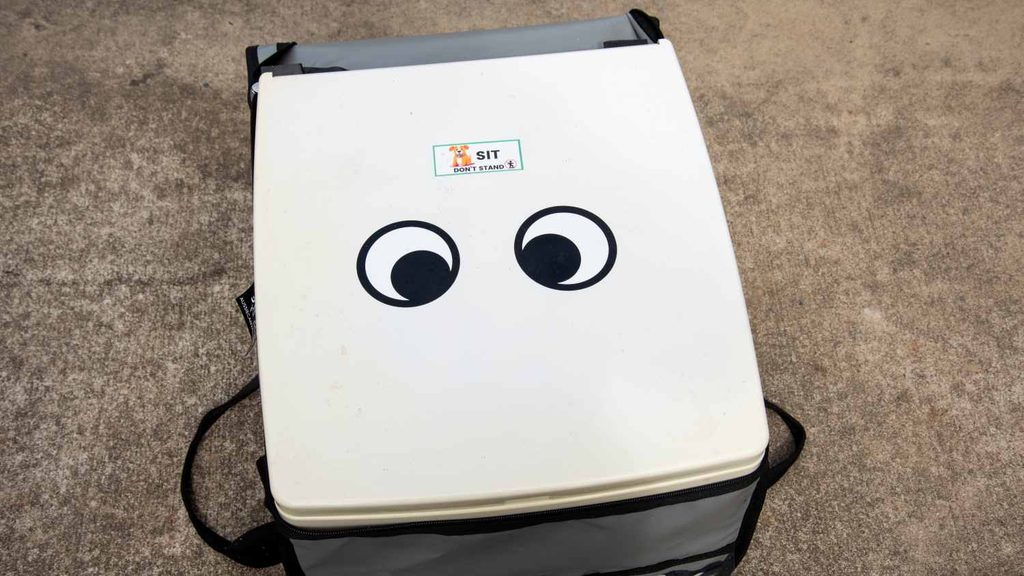
Oh, and there’s one final piece of setup that’s entirely optional. The Cuddy comes with a set of giant eyeball stickers so you can give your new toilet a little personality. I haven’t yet decided whether staring into a pair of enormous cartoon eyes before going to the toilet makes the experience better or significantly more unsettling.
All the talk about urine diversion, coco coir and composting is fine, but ultimately there’s one thing that really matters: what’s the Cuddy actually like to sit on and use?
Yes, although it does feel a little different at first. At home, you get used to your own toilet seat, its height and where everything is positioned. The Cuddy feels a little lower than a normal household toilet, but that’s hardly surprising for something designed to be portable enough to take camping.
Stability is surprisingly good. The Cuddy is quite square with a reasonably broad footprint, so as long as you place it on firm, level ground, it feels very solid for a portable toilet. Overall, I’d call it comfortable and very stable for what it is.
Yes, but initially you do have to wrap your head around the whole “one hole for wees, another for poos” concept.
The Cuddy does a good job of directing urine towards the collection bottle at the front, while there’s a generously sized opening at the rear for number twos. Cuddy says its the biggest on the market. In other words, you’d have to try pretty hard to miss.
Ideally, you wee first with the solids opening closed. Then you turn a small knob which opens what I call the “bum flap”, allowing number twos to drop into the solids bin. Doing things in that order helps prevent urine from making its way into the composting section.
But what about those times when nature isn’t prepared to follow your carefully planned sequence of events? You know you need to go, but you’re not entirely confident you can wee without also pooing.
Thankfully, that’s not the disaster you might imagine. The urine diverter does a surprisingly good job of sending everything where it needs to go, even when your body decides it’s time for multitasking.
For men, it’s a slightly different story.
Because the urine collection area is at the front of the bowl, using the Cuddy for a wee basically means sitting down. Admittedly, when we’re camping in the bush, the male members of our family will generally choose a conveniently located tree instead.
If you do use the Cuddy, however, you’ll need to sit down and, well, manhandle the goods and/or lean forward enough to make sure everything is pointing in the right direction.
Does that feel a bit weird initially? Apparently, yes. As a woman, I’m not exactly qualified to provide a first-hand assessment of the technique, but I’m old enough and have lived with men long enough to confirm that it can indeed be done.
This, for me, is one of the biggest advantages of the Cuddy. It smells WAY more pleasant than a chemical toilet.
Chemical toilets can sometimes develop that unmistakable combination of human waste and artificial fragrance. You know the one. It’s a bit like spraying air freshener after someone has destroyed the bathroom and now it just smells like crap and flowers.
The Cuddy doesn’t smell like that at all.
Let’s be realistic, though. When somebody does a poo, there’s going to be an initial smell. And every family seems to have that one member whose efforts are considerably more offensive than everyone else’s.
But once the waste is mixed through the coco coir and, importantly, isn’t sitting in a tank mixed with urine, I’ve found that the solids bin itself gives off surprisingly little odour. If anything, there’s more of a damp, earthy smell.
I’m not suggesting you’ll be opening the lid just to enjoy the aroma, but personally, I find it considerably more pleasant than the smell of a chemical toilet. As usual, it’s always a more pleasant experience if you wait five to ten minutes after the last person used it.
Yes, you can use toilet paper with the Cuddy, but many people don’t actually put it in the solids bin (myself included). Google research told me that a lot of composting toilet users keep a small bin beside the toilet instead and so we did that. Putting your toilet paper in a separate bin means it’s not taking up valuable space in the solids container or potentially getting wrapped around the agitator.
When I bought the coco coir from Bunnings, I also grabbed a small wastepaper basket with a lid. We put a kitchen bin liner in it, sit it beside the Cuddy and all used toilet paper goes straight in there.
I’ll admit that the idea can sound a little confronting at first. In reality, you tie up the liner when the toilet paper bin is full and dispose of it appropriately, and it quickly becomes just another part of using the toilet.
The wee is collected in the container at the front and if you care to install one of those little square batteries, a little light will come on when its nearly full. I simply just made it a practice to empty it every one or two days.
Emptying it is super easy as it only contains wee and nothing else. I put the whole canister in a reusable shopping bag to discreetly carry into a public or campground toilet and simply tip it down the toilet and flush.
Alternatively, someone might be happy for you to empty it on their lemon tree.
Once you’ve finished your business, there’s one final job to do.
First, twist the knob to close the solids opening. Then pull the agitator handle out from the front of the Cuddy and turn it a few times in both directions. This mixes your latest contribution through the coco coir. Push the handle back in and you’re done.
There are, however, two things I’ve learned here.
Number one: close the bum flap before you start agitating.
If you leave it open, you’re going to get a front-row seat to what’s happening inside the solids bin as you turn the handle. If you’re particularly gaggy, you probably don’t need that kind of trauma in your life.
More importantly, bits of coco coir can flick back up through the opening while you’re mixing everything around. Close the flap and neither of these things is a problem.
Number two: there’s the handwashing conundrum.
Normally, after you’ve wiped, you wouldn’t go around touching anything else before washing your hands. Except now you need to pull out the agitator handle and give it a few turns.
So you have a decision to make.
You can accept that the agitator handle probably has invisible poop germs all over it, do the agitating and then wash your hands thoroughly afterwards. Or you can wash your hands first, come back to operate the agitator and then wash them again because, well, you’ve just touched part of a toilet.
How much this bothers you will depend entirely on where you sit on the germaphobe scale.
One of the things I like about the Cuddy is that you don’t necessarily have to use it as a composting toilet.
If you’ve bought the Cuddy Lite, you won’t have an agitator in the solids bin, so it’s designed to work more like a simple drop or bag toilet. We have the standard Cuddy with the agitator, but we also have a second solids bin without one, which means we can swap between the two setups depending on the trip.
And for short camping trips, I can see us using the non-agitating bin quite a lot.
The simplest option is to line the solids bin with an appropriate heavy-duty waterproof bin liner. Your urine is still diverted into the separate bottle at the front, but number twos drop directly into the lined solids bin.
There’s no coco coir to prepare and no agitator to turn. When it’s time to empty it, you remove and securely seal the bag and dispose of it wherever you’re legally permitted to dispose of bagged human waste.
Obviously, this is one occasion where you don’t want to cheap out on the bags. The last thing you want is to discover halfway to the bin that your bag isn’t quite as heavy-duty or waterproof as you thought. Nobody needs that particular camping story.
Whether bagged human waste can go into general rubbish will depend on where you are and the rules of the relevant council, campground or waste facility, so check before disposing of it. Is a securely sealed bag of human poo really any grosser than a bag of dog poo someone has just picked up and put in a bin? I’m not sure. But what matters here isn’t my opinion – it’s what you’re actually allowed to put in that bin.
The other option is to skip the bag and put coco coir into the non-agitating solids bin.
It works much like the regular Cuddy setup, except instead of turning an agitator after you’ve finished, you simply throw a handful of coco coir over the top of your deposit. When it’s time to empty the toilet, you deal with the contents in much the same way as you would when emptying the standard Cuddy solids bin.
The urine diversion still works exactly the same way regardless of which solids bin you’re using. Urine collects in the removable bottle and can be emptied into a regular toilet or another appropriate disposal point.
For us, I think it is. Swapping between the two bins is easy, and having both gives us the choice between using the Cuddy as a composting toilet or keeping things really simple.
If we’re heading away for a longer trip, the regular composting setup makes sense because one of its biggest advantages is being able to go much longer between emptying the solids.
But if we’re disappearing for a weekend, I’m not sure I necessarily want to prepare a batch of coco coir and set up the full composting system for what might only amount to a couple of uses.
For those trips, lining the spare bin with a heavy-duty bag is incredibly simple. I’d probably still throw a little coco coir over each deposit to help keep odours under control, then seal everything up for appropriate disposal at the end of the trip.
It’s not as environmentally appealing as avoiding a plastic bag altogether, and that’s something worth considering. But having the choice is what I like about this setup. I can use the Cuddy as a proper composting toilet when that makes sense and as a very simple bag toilet when convenience wins.
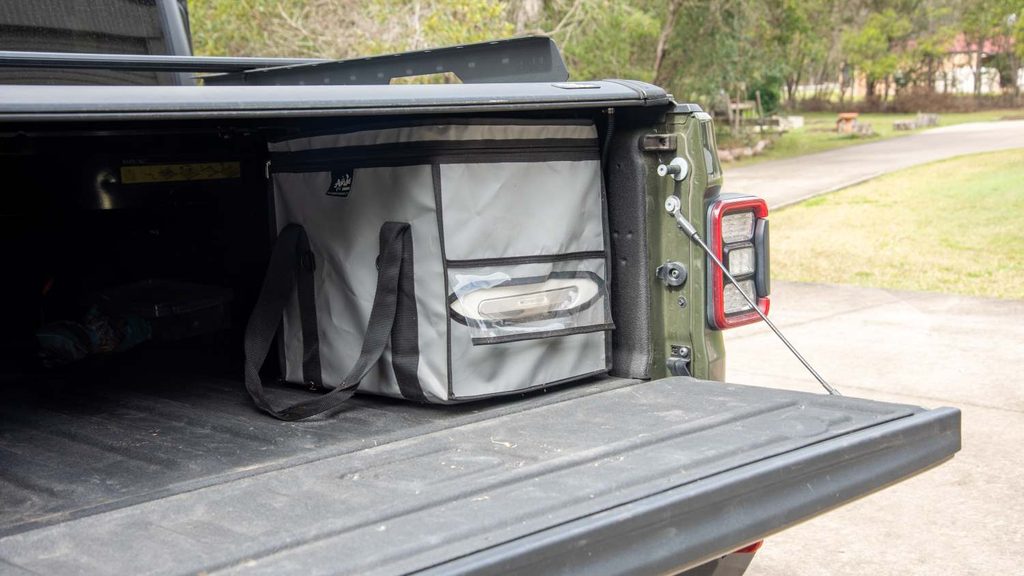
A portable toilet can be amazingly convenient at camp, but that doesn’t mean much if it’s a pain in the backside to carry around in your 4WD.
The Cuddy measures 422mm high, 385mm wide and 432mm deep, so there’s no getting around the fact that you need to allocate a reasonable chunk of cargo space to it. But its not that big. The good news is that its relatively square shape makes it easy to pack around.
Ours generally travels either in the back of our ute or in the front tunnel boot of our off-road teardrop camper, depending on how we’ve packed for the trip.
I found the Cuddy a little awkward to carry on its own, particularly once there’s some weight in the solids bin. It’s not necessarily ridiculously heavy, but its size and shape don’t make it the easiest thing to grab and lug around at arms reach. No one wants to cuddle carry a toilet.
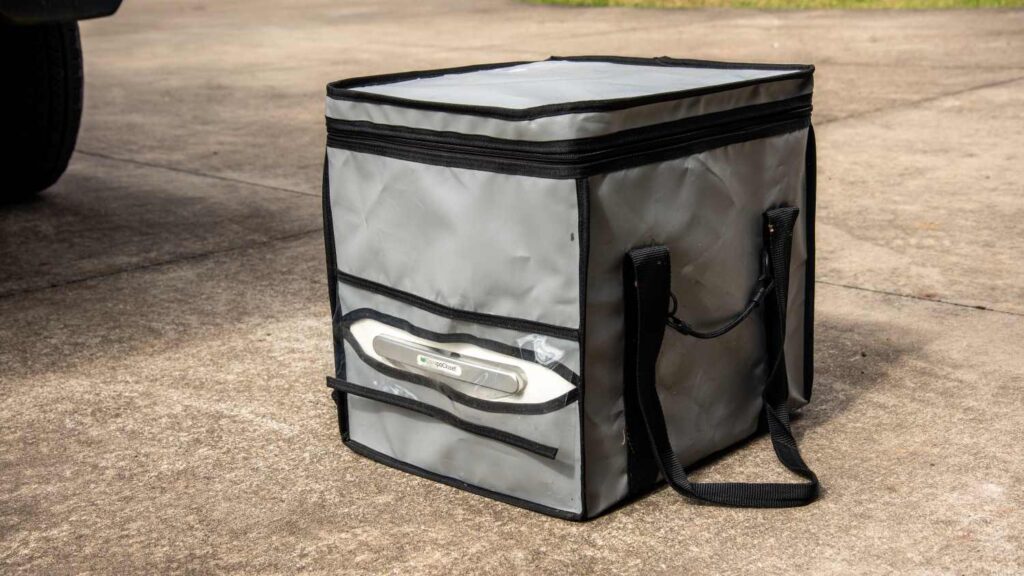
The optional Cuddy travel bag made a big difference. The handles give you something decent to grab onto, and if the toilet is full, having one person take a handle on either side makes lifting it into the ute considerably easier. I can heave it up there myself, but given the choice, I’d much rather recruit another set of hands.
The bag is a tight fit and zips closed around the toilet, which keeps the lid securely shut when you’re lifting it, moving it around or bouncing along a rough track.
For the way we travel, I think the optional bag is well worth having.
Would I want the Cuddy sitting inside the passenger compartment of my vehicle after we’d used it? Personally, no. But I didn’t like the idea of travelling with our used chemical toilet inside the vehicle either. It’s less about there actually being a smell and more about knowing what’s in there.
Thankfully, having a ute means I don’t have to share my personal space with it. The Cuddy travels happily in the tray, and we’ve had no issues with odours while transporting it.
I also make a point of emptying the urine bottle before it goes back in the vehicle. Apart from reducing the weight, it means there’s less liquid sloshing around while we’re driving and removes one potential source of leaks.
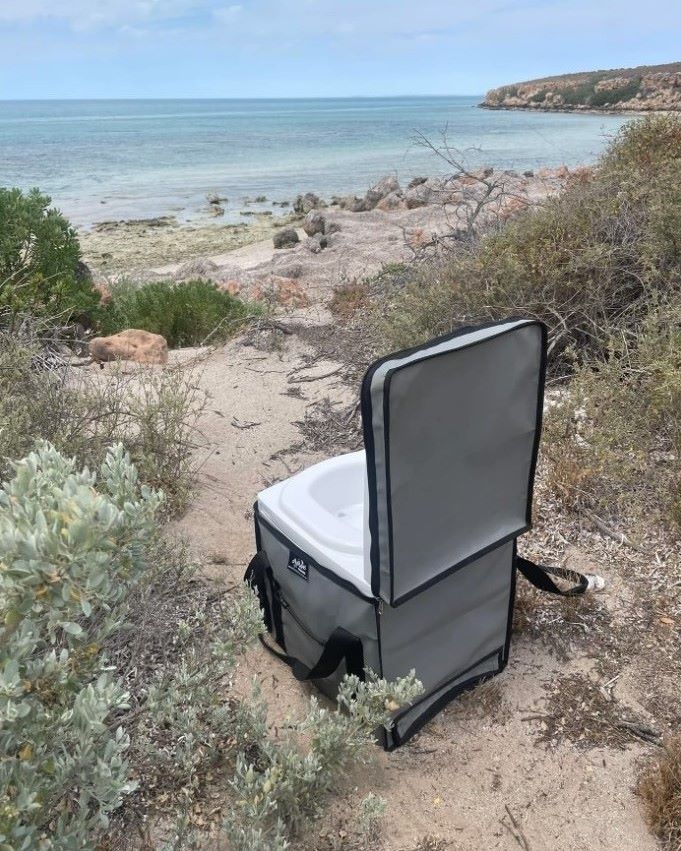
Let’s be honest, nobody buys a camping toilet because they’re looking forward to emptying it. The real question is how unpleasant the job is going to be. And this is another area where, for me, the Cuddy beats a chemical toilet.
The urine is the easy part.
The 6.5-litre bottle simply pulls out from the front of the Cuddy and slots straight back in when you’re finished. There’s no complicated mechanism to deal with and, because it contains urine rather than a delightful cocktail of wees, poos, chemicals and flush water, I find the whole process considerably less offensive than emptying a chemical toilet cassette.
Where and how you can dispose of urine will depend on where you are, so you’ll need to follow the rules of the campground, land manager or local authority. When there’s a regular toilet available, that’s an easy disposal option as you can tip it straight in.
Strangely enough, I found emptying the solids less unpleasant the longer they’d been sitting in the Cuddy.
That’s because over time, with regular agitation through the coco coir, what’s in the solids bin starts looking less like poo and more like dirt. By the time I emptied ours, it certainly wasn’t something I’d like to stick my hands in, but it also wasn’t remotely comparable to opening a chemical toilet cassette full of raw sewage.
We used the Cuddy for 10 days with four people and could probably have squeezed another couple of days out of it before the solids bin was full. Based on our experience, CompoCloset’s claim of around two to three weeks of full-time use for two people seems pretty realistic.
Obviously, capacity will vary considerably depending on how often you use it, whether everyone in your group is using it and whether you’re putting toilet paper into the solids bin.
This is where things become a little more complicated because appropriate disposal depends on where you live and the applicable local regulations.
We live on five acres, so we have options that someone living on a suburban block obviously won’t have. After returning home, we allowed the contents to continue breaking down for another few weeks before dealing with them. By that point, the contents had broken down considerably and looked much more like an earthy compost mixture than a bucket of human waste.
For our particular situation, we were comfortable disposing of the material in an isolated area among the trees at the far end of our property, well away from where anyone spends time. Realistically, the only regular visitors up there are the kangaroos.
However, that’s our experience rather than disposal advice. Human waste can contain pathogens even when it looks like compost, and regulations governing its disposal vary between councils, states and land managers. You should check what’s permitted where you live rather than assuming composting toilet waste can simply be tipped onto your garden or into the bush.
When I was researching composting toilets before buying the Cuddy, another method I regularly saw owners discussing was emptying the solids into a heavy-duty garbage bag, sealing it and putting it into general waste where local regulations permit.
If we lived on a normal suburban block rather than five acres, that’s probably the option I’d investigate first.
Not really. Once the solids bin was empty, I gave it a hose out and left it sitting in the sun for a few hours to dry. The rest of the Cuddy got a good wipe-down before everything was packed away until our next trip. That was pretty much it.
The urine bottle is similarly easy to remove for cleaning, and so far we haven’t experienced any leaks from either the urine bottle or the toilet itself. For something whose entire purpose revolves around dealing with human waste, the cleanup is surprisingly straightforward.
It’s probably one of the things that has surprised me most about the Cuddy. Emptying a chemical toilet always felt like dealing with sewage because, essentially, that’s exactly what you’re doing. With the Cuddy, I’m dealing with a bottle of urine and a separate container of solids that, given enough time, increasingly resembles damp earth.
I’m not going to pretend emptying any camping toilet is an enjoyable Sunday afternoon activity. But after experiencing both, I’ll take emptying the Cuddy over a chemical toilet cassette any day.
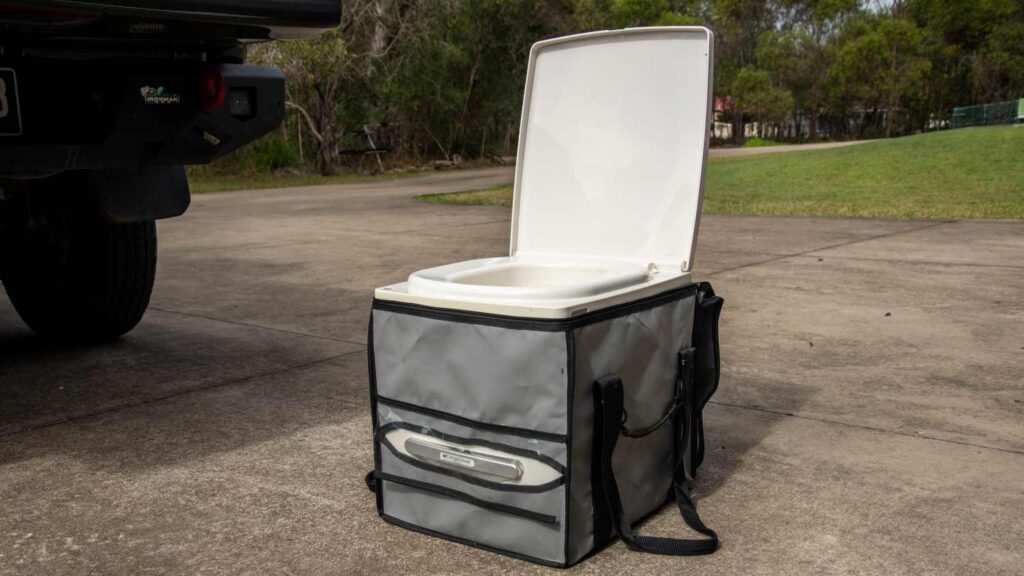
One of the reasons I was originally attracted to the Cuddy was the possibility that it might be a more environmentally friendly option than the chemical toilet we’d been using.
But is it actually better for the environment?
There are certainly some obvious advantages. The Cuddy doesn’t use any water for flushing, and there are no chemical toilet additives going into the waste. There’s also no requirement to use a plastic liner when you’re using the standard Cuddy in composting mode. We put the coco coir directly into the solids bin, so we’re not wrapping every deposit in plastic before throwing it away.
That’s one of the things that appeals to me about the Cuddy compared with a dry-flush sealing toilet. Those toilets can be incredibly convenient because they seal solid waste into bags, but that convenience can also create an ongoing stream of plastic waste. Some newer designs reduce the amount of plastic used, but it’s still something to consider.
Of course, the Cuddy isn’t completely without environmental trade-offs.
Coco coir needs to be produced, processed, packaged and transported, and what happens to the contents of your solids bin ultimately matters too. A composting toilet doesn’t magically make the potential pathogens in human waste disappear the moment you’ve turned the agitator a few times. Appropriate disposal is still important, and what you’re permitted to do with the waste varies depending on where you live and camp.
So, after actually living with the Cuddy compost toilet, would I buy one again?
Absolutely.
I’ll admit that I went into this expecting a certain amount of grossness. The idea of carrying our poo around in a bucket of coco coir and then eventually having to empty it didn’t exactly sound like one of the more glamorous aspects of camping. But the reality has been nowhere near as bad as I’d imagined.
The biggest surprise was the lack of smell. Yes, there’s an initial smell when someone does their business – there’s no getting around biology – but once it’s mixed through the coco coir, we’ve had very little odour from the solids bin itself. Compared with the distinctive crap-and-flowers aroma that chemical toilets develop, I’ll take damp earth any day.
The other big surprise was how long we could go between emptying the solids. Four of us used the Cuddy over a 10-day camping trip and probably could have stretched it another couple of days. And ultimately, that’s the biggest advantage for me. When we’re camping somewhere off-grid, I don’t want our itinerary dictated by how soon we need to find a dump point.
What’s the biggest drawback? The price. At $1795 its an investment rather that a ”let’s see how it goes”. Despite this, I think its well worth it for the ability to ditch the chemicals and go longer between emptying.
Would I go back to our chemical toilet? Not unless I had to.
This article contains affiliate links to products. We may receive a commission for purchases made through these links.